
In this post I am going to talk about something I was not really planning to talk about—the nakshatras or lunar mansions. The reason I was not planning to talk about them, not planning to talk about them for quite some time I thought, was because, frankly speaking, I do not know most of the nakshatras. I may be able to list them all out for you, but I have little experience with most of them—few observations, few opinions. I don’t want to pretend to be an expert which is something I’ve been wont to do in the past.
But I have realized in my inspiration for this post that I do not have to be an expert in all of the nakshatras to talk about them. I do not even need to be an expert in any of the nakshatras to talk about them. There would be little reason to talk about the nakshatras that I have little experience with, but in this case I do have some experience—Dhanishta is where my Sun and Saturn are located.
Also I mainly want to talk about Dhanishta, one, because it relates to some interesting and important aspects of life—not only my life but all life—and two, because in my researching Dhanishta, I found very little good information about it or what I was hearing at first was just not resonating.
The Best Resources for Understanding the Nakshatras
First of all, I want to share the best resources I have found thus far for understanding and learning about the nakshatras.
The place I first began learning about them—and still to this day, the single best place I have found for learning about them—is Vic DiCara’s videos and books. As with all things, your mileage may vary. Other teachers, other content may speak to you. But Vic DiCara is such an excellent storyteller and has such a deep, personal relationship with the stories that he shares, the content that he teaches.
So much of mythology is dry, cold, lifeless. It is these old tales that we are told are important—we might even feel them to be important ourselves—but they have so little relevance. At least it can seem that way. This is because most mythology, like most knowledge in general, is regurgitated.
This regurgitation phenomenon, which I will admit I have suffered from (as a regurgitator) and probably still do, is such a bane of existence, such a blight on the earth!
I am not exaggerating when I say that. Perhaps many of us do not like to hear this because we are the regurgitators. Our entire lives may be devoted to regurgitation and to our ability to regurgitate “well”. But we need to get over it…
Astrology Requires Both Knowledge and Wisdom
On the one hand there is value in preserving works, especially ancient and important works, verbatim. There is value to memorization and honest recital of memorized stories. I am grateful for those who do this valuable work, who keep traditions alive, because I do not do that and someone needs to! But what I am speaking to with regards to regurgitation is something else.
The regurgitation problem occurs when a person tries to take credit for what they have only received from others. It is also when they try, due to defensiveness (the defensiveness that comes from not actually knowing, at a personal, deep, or meaningful level, anything), to imply that their way of describing or defining is the way. Because here is the fundamental problem: even if your way is the most tried-and-true way, even if it is that way that has been passed down through the ages, times change!
Even though there is value to preservation, there is still a need for experience and for relating what you have learned to how people are living now (which almost certainly differs from how people lived hundreds or thousands of years ago). In fact it is precisely the people who fail to adapt or fail to open themselves up to experience outside of the mental constructs that were given to them, who cause the death of traditions.
If they cared about the tradition they would question it. They would consider other traditions too.
If you are a scribe, be a scribe and be proud. That is noble work. It does not mean that you cannot have opinions or fight important battles. Your opinions and battles might be mostly related to language and history. But if you are a scribe, do not pretend to be an astrologer… or at least do not pretend to be a guide. Though it may be possible to make routine calculations and predictions without understanding—in the same way a computer does it—and though those predictions may even have value, when we are talking about guiding people, that is something else entirely. It requires keeping a distance from words and concepts, not being too attached to them, because every person is different. Every person has different words, different concepts.
As an astrologer, we work with clients who do not know or really care about astrology. In order to work effectively with them, we need to be able to meet them where they are at, to speak their language. We need patience and emotional maturity. We need to appreciate, through our own experience, that everyone has their own path to walk and that their path is just as correct or true as ours. The more we are caught up in ego games, the less open and available we will be with clients.
The goal of astrology is not to be more right than this other faction. The goal is to flow, as best as possible, with the energies of life. Having a pure and proper system is important, but having our heart in the right place and being centered from the heart is more important. Because when we are heart-centered, we will be led to the right system, and we will appreciate that the system isn’t everything. Presence is more important than system.
If you want to learn about the nakshatras, start with Vic DiCara and then learn from personal observation—through transits, your own chart, other people’s charts. Take it slow because there are a lot of them! (27 or 28, depending on the system.)
I would be happy to recommend any other good sources if I knew of them, but really I do not. There are other sources which add to the picture. I have learned from many places. But there are no other single sources I’ve found that are recommendation-worthy. I am not one of those sources either yet!
Background
Let me start by giving some background on the lunar mansions in general, what they are “all about”. This will mainly be for any people who stumble onto this article and it is their first exposure to the nakshatras.
The lunar mansions or nakshatras are stars first and foremost. We could call them constellations as they do form constellations, but most nakshatras correspond to one star or at most two. There is something confusing about the fact that they are stars, or related to stars, which I will go ahead and mention. This is the fact that the regions of the ecliptic that are given to each star—the regions that allow us to say “The Moon is in Jyestha” or “Venus is in Ashwini”—do not always even contain that star.
Generally the star is near the beginning of the field or region, so it is consistent in that way. But there is some variation. I have asked one reputable astrologer about this confusion, and they pointed out, as a way of consoling me, that the nakshatras are not even on the ecliptic to begin with. They are usually some amount north or south of it. And hence, their reasoning went, we should not really be too caring of the ecliptic regions that contain the star (through a kind of mathematical projection).
That did not really console me but, you know, it seems to work… (If you have ideas on this, please let me know, but it is not something I worry about these days.)
Suffice it to say though that each nakshatra is associated with one or two stars but those one or two stars might be a little ways away from where the ecliptic region is that is given to the star/s.
Secondly I would just like to say that the lunar mansions are important! To me they are equally important to the zodiac we are familiar with (Aries -> Pisces). That zodiac is the solar zodiac, while the lunar mansions are the lunar zodiac. As the Sun and Moon are equally important, it should make sense why the two zodiacs are equally important.
The Two Zodiacs and Their Qualities
Often for the sake of convenience we say that astrology relates to the stars (it is astro-ology after all, the study of stars). And yet, we use a solar zodiac—a zodiac based on seasons rather than consistent stellar position—and when the Sun is out, we cannot even see the stars!
I am probably riling up a turf war here. But really I just want to point out a basic observation: when the Sun is out, we cannot see the stars. When the Moon is out, we can. (Clouds willing)
To me, it is this very basic observation that suggests why using tropical zodiac + sidereal nakshatras makes sense. Not that I am entirely against the sidereal zodiac, or not even that I have a strong opinion about it, but I just wanted to throw this out there…
In any case, the qualities of each of these zodiacs and how we understand them very much reflects their patron luminary. The solar zodiac has structure. It is something we can reason about. What is the structure? Primarily it is the pattern of elements (Fire, Earth, Air, Water) and modes (Cardinal, Fixed, Dual). There is also a nice structure to the traditional rulerships. There is the consistent progression from Aries to Pisces, each sign expanding the scope of the previous and moving from birth to oneness.
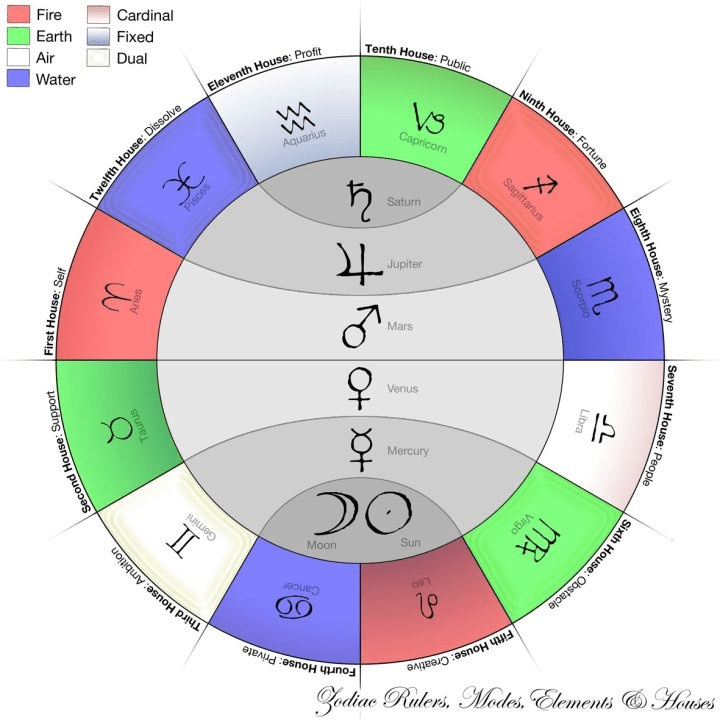
Source: Vraja Kishor (Vic DiCara)
On the other hand, the lunar zodiac does not have structure like that. There is some amount of order. Many nakshatras relate to the one or ones before and after and it can even be argued that the entire cycle tells a story. But for the most part, we have to rely on intuition, imagination, and subtlety to understand the nakshatras—all lunar qualities.
The primary qualities of the nakshatras are the symbol and the deity. There are other qualities, but I would claim that those are secondary for really getting to the essence. To interpret a nakshatra, we must extrapolate from the mythological stories of the deity and we must contemplate the symbol, inviting our intuition to run with it.
Beyond that, there are different ways that nakshatras manifest in our lives and personalities compared to the signs. There is some overlap. For example, Krittika being the domain of Agni (Fire) is going to make for a fiery person, if for example, their Moon is there. Although it lies in either Taurus or Gemini tropically, you might find, at a deeper level, a fire that can be understood as coming from the nakshatra. At the very least you will find a major difference compared to people with Taurus or Gemini placements in other nakshatras.
Just to give one example, Vladimir Putin has his Moon in Krittika. I find it difficult to believe that someone so ruthless could have their Moon in, say, Mrgasirsha or Rohini (the other Gemini nakshatras). Not that there are not other aspects to his ruthlessness—Scorpio rising and Pluto on the Midheaven stand out as quite obvious. As always we have to look at a whole chart. But at the very least when I saw Krittika for him I was not surprised. My closest acquaintance with a Krittika Moon is a successful entrepreneur. Very direct and incisive as the knife symbol would suggest. She also has a BIG heart and is a wonderful person. I don’t want to give any bad impression of Krittika. I only want to say that in my experience, it always checks out.
Primarily what I wanted to say though is that the nakshatras are not merely these obvious energetic qualities that are visible at any given moment. They are but in addition to that or perhaps more importantly than that, they are mythic themes that show up in our lives.
They are entire trajectories—stories, lessons—just as myths are. The qualities often show up in similar ways to how the myths play out.
In Part II, we discuss the prominent themes for Dhanishta.
 Travis Astrology
Leave a comment